Thank you so much to the staff of Tenth Presbyterian church for your visit today
and for all of your support.
Tuesday, December 19, 2006


Thursday, December 14, 2006
THE STAR OF BETHLEHAM...... BY DR. PHILLIP RYKEN

The star was so beautiful, large, and clear,
That all the other stars of the sky
Became a white mist in the atmosphere.
And by this they knew that the coming was near
Of the Prince foretold in prophecy.
Thus wrote Henry Wadsworth Longfellow concerning the star of Bethlehem, which of all the signs and wonders surrounding the first Christmas is perhaps the most mysterious.
The Bible says that some time after Jesus was born, “Magi from the east came to Jerusalem and asked, ‘Where is the one who has been born king of the Jews? We saw his star in the east and have come to worship him’ ” (Matt. 2:1-2). The Magi obviously had an interest in astronomy. Probably they were astrologers, men who consulted the stars to make predictions about what was happening in the world. As they studied the heavens, they saw something to indicate that a king had been born in Judea, but what, exactly, did they see?
There have been many theories. Some Christians think that the star was a supernatural light—something never seen before, or since. They imagine it hovering over the Magi on their journey, directly guiding them until finally coming to rest a few feet over the house where Jesus was. Others think it was a comet or a conjunction of planets. Johannes Kepler thought it was a supernova—an exploding star. Still others think it was a meteor shower. In 2001, the noted British astronomer Sir Patrick Moore published a book arguing that the bright light that identified the birthplace of Christ could only have been caused by shooting stars [The Star of Publishing, Canopus, 2001].
What are we to make of this and other theories? The place to start is with the biblical facts. First there is the word “star,” which seems straightforward enough. However, the Greek word does not settle the matter because it can also refer to other heavenly objects.
The next fact to notice is that the Star of Bethlehem made a sudden appearance. Literally, the Wise Men saw it “rising in the east” (Matt. 2:2). Presumably they had never seen anything like it. Otherwise, why would they have followed it? The star’s sudden emergence is confirmed by King Herod, who “called the Magi secretly and found out from them the exact time the star had appeared” (Matt. 2:7).
The star disappeared just as suddenly as it appeared. This is why the Magi stopped in Jerusalem to ask for directions instead of going straight to Bethlehem. Then the star reappeared! This is the clear implication of verses 9 and 10: “After they had heard the king, they went on their way, and the star they had seen in the east went ahead of them until it stopped over the place where the child was. When they saw the star, they were overjoyed.”
It is of course possible that the Magi saw some supernatural light that God kept bringing in and out of the sky as needed. However, in that case one would expect other people to have seen it and perhaps even to have followed it. The trouble is that there is no record of any such celestial event during the appropriate time period. Nor are there any records of comets or novas. In all probability the Star of Bethlehem was a subtler sign, the kind of thing that only experts like the Magi would have even noticed.
The most convincing explanation is that they witnessed several conjunctions of Jupiter, the planet that represented kingship. A number of such conjunctions took place in the years leading up to the death of Herod. In its annual program “Star of Wonder,” Chicago’s Adler Planetarium makes a persuasive case for one of these celestial events. This view is also advocated by Craig Chester of the Monterey Institute for Research in Astronomy, who writes,
In September of 3 b.c., Jupiter came into conjunction with Regulus, the star of kingship, the brightest star in the constellation of Leo. Leo was the constellation of kings, and it was associated with the Lion of Judah. The royal planet approached the royal star in the royal constellation representing Israel. Just a month earlier, Jupiter and Venus, the Mother planet, had almost seemed to touch each other in another close conjunction, also in Leo. Then the conjunction between Jupiter and Regulus was repeated, not once but twice, in February and May of 2 b.c. Finally, in June of 2 b.c., Jupiter and Venus, the two brightest objects in the sky save the sun and the moon, experienced an even closer encounter when their disks appeared to touch; to the naked eye they became a single object above the setting sun. This exceptionally rare spectacle could not have been missed by the Magi [Craig Chester, “The Star of Bethlehem,” Imprimis, December, 1993, Vol. 22, No. 12].
When the Magi saw this “star,” they headed for Jerusalem. The Bible does not say that they followed the star at this point in their journey, but only that they went to Judea. They did follow the star to Bethlehem. They would have seen Jupiter and Venus in the south, and followed it the five miles to Bethlehem. When they reached the village they would have seen it above the horizon—from their perspective stopping over the place where the child was.
If one of these astronomical events involving Jupiter is the right interpretation, it is a remarkable testimony to God’s sovereignty. It means that from the very creation of the world, God organized the solar system—and indeed the entire universe—in a way that would signify the birth of his Son and our Savior, Jesus Christ.
It is also a remarkable testimony to God’s grace. How strange it is that the Savior’s birth was first revealed to astrologers. God had always forbidden astrology. Nevertheless, he used a heavenly sign to lead the Magi to Jesus. This does not mean that God condones horoscopes. It does mean that he speaks to people where they are, in ways that they can understand, in order ultimately to lead them to himself. The Magi did not know anything about Jesus when they first set out for Judea. But they followed the one clue that God gave them, and in the end they met him as their Savior and Lord.
Jesus said “he who seeks finds” (Matt. 7:8). That is still true today. Everyone who truly seeks after God will find him. God is not likely to send you a star, or even a planetary conjunction. But he has given you a clue. Tonight he has led you to a church where a word from God will be preached from this pulpit. If you keep seeking him you too will find him.
THE HISTORY OF X--MAS.
"Xmas" and "X-mas" are common abbreviations of the word "Christmas". They are sometimes pronounced "eksmas", but they, and variants such as "Xtemass", originated as handwriting abbreviations for the pronunciation "Christmas". The "-mas" part came from the Anglo-Saxon for "festival", "religious event": Crīstesmæsse or Crīstemæsse. This abbreviation is widely but not universally accepted; some view it as demeaning to Christ, whilst others find it a helpful abbreviation.
This 1922 Ladies' Home Journal advertisement uses "Xmas".The word "Christ" and its compounds, including "Christmas", have been abbreviated for at least the past 1,000 years, long before the modern "Xmas" was commonly used. "Christ" was often written as "XP" or "Xt"; there are references in the Anglo-Saxon Chronicle as far back as 1021 AD. This X and P arose as the uppercase forms of the Greek letters χ and ρ), used in ancient abbreviations for Χριστος (Greek for "Christ") (see Labarum), and are still widely seen in many Eastern Orthodox icons depicting Jesus Christ.
Some people believe that the term is part of an effort to "take Christ out of Christmas" or to literally "cross out Christ"; it is also seen as evidence of the secularization of Christmas or a vehicle for pushing political correctness, or as a symptom of the commercialization of the holiday (as the abbreviation has long been used by retailers).
The occasionally felt belief that the "X" represents the cross Christ was crucified on has no basis in fact; regardless, St Andrew's Cross is X-shaped, but Christ's cross was probably shaped like a T or a †. Indeed, X-as-chi was associated with Christ long before X-as-cross could be, since the cross as a Christian symbol developed later. (The Greek letter Chi Χ stood for "Christ" in the ancient Greek acrostic ΙΧΘΥΣ ichthys.) While some see the spelling of Christmas as Xmas a threat, others see it as a way to honor the martyrs. The use of X as an abbreviation for "cross" in modern abbreviated writing (e.g. "Kings X" for "Kings Cross") may have reinforced this assumption.
In ancient Christian art χ and χρ are abbreviations for Christ's name. In many manuscripts of the New Testament and icons, X is an abbreviation for Christos, as is XC (the first and last letters in Greek, using the lunate sigma); compare IC for Jesus in Greek. The Oxford English Dictionary documents the use of this abbreviation back to 1551, 50 years before the first English colonists came to North America and 60 years before the King James Version of the Bible was completed. At the same time, Xian and Xianity were in frequent use as abbreviations of "Christian" and "Christianity"; and nowadays still are sometimes so used, but much less than "Xmas". The proper names containing the name "Christ" other than aforementioned are rarely abbreviated in this way (e.g. Hayden Xensen for the actor name "Hayden Christensen"). Pop artist Christina Aguilera is known to spell her first name as 'Xtina'.
This apparent usage of "X" to spell the syllable "kris" (rather than the sounds "ks") has extended to "xtal" for "crystal", and on florists' signs "xant" for "chrysanthemum" (though these words are not etymologically related to "Christ"; "crystal" comes from a Greek word meaning "ice", and "chrysanthemum" from Greek words meaning "golden flower", while "Christ" comes from a Greek word meaning "anointed").
This 1922 Ladies' Home Journal advertisement uses "Xmas".The word "Christ" and its compounds, including "Christmas", have been abbreviated for at least the past 1,000 years, long before the modern "Xmas" was commonly used. "Christ" was often written as "XP" or "Xt"; there are references in the Anglo-Saxon Chronicle as far back as 1021 AD. This X and P arose as the uppercase forms of the Greek letters χ and ρ), used in ancient abbreviations for Χριστος (Greek for "Christ") (see Labarum), and are still widely seen in many Eastern Orthodox icons depicting Jesus Christ.
Some people believe that the term is part of an effort to "take Christ out of Christmas" or to literally "cross out Christ"; it is also seen as evidence of the secularization of Christmas or a vehicle for pushing political correctness, or as a symptom of the commercialization of the holiday (as the abbreviation has long been used by retailers).
The occasionally felt belief that the "X" represents the cross Christ was crucified on has no basis in fact; regardless, St Andrew's Cross is X-shaped, but Christ's cross was probably shaped like a T or a †. Indeed, X-as-chi was associated with Christ long before X-as-cross could be, since the cross as a Christian symbol developed later. (The Greek letter Chi Χ stood for "Christ" in the ancient Greek acrostic ΙΧΘΥΣ ichthys.) While some see the spelling of Christmas as Xmas a threat, others see it as a way to honor the martyrs. The use of X as an abbreviation for "cross" in modern abbreviated writing (e.g. "Kings X" for "Kings Cross") may have reinforced this assumption.
In ancient Christian art χ and χρ are abbreviations for Christ's name. In many manuscripts of the New Testament and icons, X is an abbreviation for Christos, as is XC (the first and last letters in Greek, using the lunate sigma); compare IC for Jesus in Greek. The Oxford English Dictionary documents the use of this abbreviation back to 1551, 50 years before the first English colonists came to North America and 60 years before the King James Version of the Bible was completed. At the same time, Xian and Xianity were in frequent use as abbreviations of "Christian" and "Christianity"; and nowadays still are sometimes so used, but much less than "Xmas". The proper names containing the name "Christ" other than aforementioned are rarely abbreviated in this way (e.g. Hayden Xensen for the actor name "Hayden Christensen"). Pop artist Christina Aguilera is known to spell her first name as 'Xtina'.
This apparent usage of "X" to spell the syllable "kris" (rather than the sounds "ks") has extended to "xtal" for "crystal", and on florists' signs "xant" for "chrysanthemum" (though these words are not etymologically related to "Christ"; "crystal" comes from a Greek word meaning "ice", and "chrysanthemum" from Greek words meaning "golden flower", while "Christ" comes from a Greek word meaning "anointed").
A CHRISTMAS POEM
In todays day and time,
it's easy to lose sight,
of the true meaning of Christmas
and one special night.
When we go shopping,
We say "How much will it cost?"
Then the true meaning of Christmas,
Somehow becomes lost.
Amidst the tinsel, glitter
And ribbons of gold,
We forget about the child,
born on a night so cold.
The children look for Santa
In his big, red sleigh
Never thinking of the baby
Whose bed was made of hay.
In reality when we look into the night sky,
We don't see a sleigh
But a star, burning bright and high.
A faithful reminder,
Of that night so long ago,
And of the child we call Jesus,
Whose love, the world would know.
BY Brian Walters
--------------------------------------------------------------------------------
it's easy to lose sight,
of the true meaning of Christmas
and one special night.
When we go shopping,
We say "How much will it cost?"
Then the true meaning of Christmas,
Somehow becomes lost.
Amidst the tinsel, glitter
And ribbons of gold,
We forget about the child,
born on a night so cold.
The children look for Santa
In his big, red sleigh
Never thinking of the baby
Whose bed was made of hay.
In reality when we look into the night sky,
We don't see a sleigh
But a star, burning bright and high.
A faithful reminder,
Of that night so long ago,
And of the child we call Jesus,
Whose love, the world would know.
BY Brian Walters
--------------------------------------------------------------------------------
Monday, December 11, 2006
THE MANGER OF YESTERDAY, TODAY, AND FOREVER
The Bible is the cradle wherein Christ is laid.
Martin Luther
Martin Luther
BIBLE EXHIBITION
Bible Exhibition
Jessie Bible sent this in:
I recently heard that there is an illumined, hand calligraphied Bible being done by Donald Jackson under the auspices of a Benedictine Abbey. It's called the Saint John's Bible. I've seen some of the illuminations online, and they are absolutely breathtaking. You can learn more at http://www.saintjohnsbible.org
The Saint John's Bible manuscripts for Psalms, the Gospels, Acts, and the Pentateuch is on display at the Library of Congress in Washington DC through December 30. A number of rare Bibles will be on display as well. You can get information on the exhibition called "Illuminating the Word: the Saint John's Bible" at http://www.loc.gov/exhibits/ex-current.html
One person who had seen facsimiles of the Saint John's Bible commented that seeing them made her want to run out and see the originals. I can totally understand - after seeing what I have seen, I feel compelled to go to DC before the exhibition closes. (The exhibition schedule runs through 2009 & does not show any more exhibitions on the East Coast).
posted by M Clark of tenth press.
Jessie Bible sent this in:
I recently heard that there is an illumined, hand calligraphied Bible being done by Donald Jackson under the auspices of a Benedictine Abbey. It's called the Saint John's Bible. I've seen some of the illuminations online, and they are absolutely breathtaking. You can learn more at http://www.saintjohnsbible.org
The Saint John's Bible manuscripts for Psalms, the Gospels, Acts, and the Pentateuch is on display at the Library of Congress in Washington DC through December 30. A number of rare Bibles will be on display as well. You can get information on the exhibition called "Illuminating the Word: the Saint John's Bible" at http://www.loc.gov/exhibits/ex-current.html
One person who had seen facsimiles of the Saint John's Bible commented that seeing them made her want to run out and see the originals. I can totally understand - after seeing what I have seen, I feel compelled to go to DC before the exhibition closes. (The exhibition schedule runs through 2009 & does not show any more exhibitions on the East Coast).
posted by M Clark of tenth press.
Friday, December 08, 2006
OH NO!!!!!!! NOT THE CHRISTMAS TREE CHARLIE BROWN
Should Christians have Christmas trees?
Answer:
I see nothing wrong with the traditional Christmas tree. However, some have taught that it's wrong for anyone to have a Christmas tree in their home. But are their reasons valid? We don't think so. Let's look at the two most common objections people make against having a Christmas tree.
First, some object on the basis that Christmas trees have pagan origins. It is believed that Boniface, English missionary to Germany in the eighth century, instituted the first Christmas tree. He supposedly replaced sacrifices to the god Odin's sacred oak with a fir tree adorned in tribute to Christ. But certain other accounts claim that Martin Luther introduced the Christmas tree lighted with candles. Based on that information you could say the Christmas tree has a distinguished Christian pedigree.
However, even if a pagan background were clearly established, that wouldn't necessarily mean we could not enjoy the use of a Christmas tree. Perhaps the following analogy will help.
During World War II the American military used some remote South Pacific islands for temporary landing strips and supply depots. Prior to that time the indigenous tribal people had never seen modern technology up close. Large cargo planes swooped in filled with an array of material goods, and for the first time the islanders saw cigarette lighters (which they deemed to be miraculous), jeeps, refrigerators, radios, power tools, and many varieties of food.
When the war was over, the islanders concluded that the men who brought cargo were gods, so they began building shrines to the cargo gods. They hoped the cargo gods would return with more goods.
Most people do not even know about this religious superstition. Similarly, few know anything about the worship of trees. When a child pulls a large present out from under the Christmas tree and unwraps a large model cargo plane, no one views that object as an idol. Nor do we view the Christmas tree to be some kind of gift god. We understand the difference between a toy and an idol just as clearly as we understand the difference between an idol and a Christmas tree. We see no valid reason to make any connection between Christmas trees and wooden idols or the worship of trees. Those who insist on making such associations should take note of the warnings in Scripture against judging one another in doubtful things (see Romans 14 & 1 Corinthians 10:23-33).
Another common objection is the claim that Christmas trees are prohibited in Scripture. Jeremiah 10 is commonly used to support this viewpoint. But a closer look at the passage will show that it has nothing to do with Christmas trees and everything to do with idol worship. Verse eight says, "A wooden idol is a worthless doctrine."
Idol worship was a clear violation of the Ten Commandments. Exodus 20:3-6 says, "You shall have no other gods before Me. You shall not make for yourself a carved image, or any likeness of anything that is in heaven above, or that is in the earth beneath, or that is in the water under the earth; you shall not bow down to them nor serve them. For I, the LORD your God, am a jealous God, visiting the iniquity of the fathers on the children to the third and fourth generations of those who hate Me, but showing mercy to thousands, to those who love Me and keep My commandments."
There is no connection between the worship of idols and the use of Christmas trees. We should not be anxious about baseless arguments against Christmas decorations. Rather, we should be focused on the Christ of Christmas and giving all diligence to remembering the real reason for the season.
Answer:
I see nothing wrong with the traditional Christmas tree. However, some have taught that it's wrong for anyone to have a Christmas tree in their home. But are their reasons valid? We don't think so. Let's look at the two most common objections people make against having a Christmas tree.
First, some object on the basis that Christmas trees have pagan origins. It is believed that Boniface, English missionary to Germany in the eighth century, instituted the first Christmas tree. He supposedly replaced sacrifices to the god Odin's sacred oak with a fir tree adorned in tribute to Christ. But certain other accounts claim that Martin Luther introduced the Christmas tree lighted with candles. Based on that information you could say the Christmas tree has a distinguished Christian pedigree.
However, even if a pagan background were clearly established, that wouldn't necessarily mean we could not enjoy the use of a Christmas tree. Perhaps the following analogy will help.
During World War II the American military used some remote South Pacific islands for temporary landing strips and supply depots. Prior to that time the indigenous tribal people had never seen modern technology up close. Large cargo planes swooped in filled with an array of material goods, and for the first time the islanders saw cigarette lighters (which they deemed to be miraculous), jeeps, refrigerators, radios, power tools, and many varieties of food.
When the war was over, the islanders concluded that the men who brought cargo were gods, so they began building shrines to the cargo gods. They hoped the cargo gods would return with more goods.
Most people do not even know about this religious superstition. Similarly, few know anything about the worship of trees. When a child pulls a large present out from under the Christmas tree and unwraps a large model cargo plane, no one views that object as an idol. Nor do we view the Christmas tree to be some kind of gift god. We understand the difference between a toy and an idol just as clearly as we understand the difference between an idol and a Christmas tree. We see no valid reason to make any connection between Christmas trees and wooden idols or the worship of trees. Those who insist on making such associations should take note of the warnings in Scripture against judging one another in doubtful things (see Romans 14 & 1 Corinthians 10:23-33).
Another common objection is the claim that Christmas trees are prohibited in Scripture. Jeremiah 10 is commonly used to support this viewpoint. But a closer look at the passage will show that it has nothing to do with Christmas trees and everything to do with idol worship. Verse eight says, "A wooden idol is a worthless doctrine."
Idol worship was a clear violation of the Ten Commandments. Exodus 20:3-6 says, "You shall have no other gods before Me. You shall not make for yourself a carved image, or any likeness of anything that is in heaven above, or that is in the earth beneath, or that is in the water under the earth; you shall not bow down to them nor serve them. For I, the LORD your God, am a jealous God, visiting the iniquity of the fathers on the children to the third and fourth generations of those who hate Me, but showing mercy to thousands, to those who love Me and keep My commandments."
There is no connection between the worship of idols and the use of Christmas trees. We should not be anxious about baseless arguments against Christmas decorations. Rather, we should be focused on the Christ of Christmas and giving all diligence to remembering the real reason for the season.
WHY DECEMBER 25TH ????????
Why do Christians celebrate Christmas on December 25?
Answer:
December 25th is the traditional anniversary of the birth of Christ, but most scholars are unsure about the true date for Christ's birth.
The decision to celebrate Christmas on December 25th was made sometime during the fourth century by church bishops in Rome. They had a specific reason for doing so.
Having turned long ago from worshiping the one true God and creator of all things, many early cultures in the Roman empire had fallen into sun worship. Recognizing their dependence on the sun's yearly course in the heavens, they held feasts around the winter solstice in December when the days are shortest. As part of their festivals, they built bonfires to give the sun god strength and bring him back to life again. When it became apparent that the days were growing longer, there would be great rejoicing.
The church leaders in Rome decided to celebrate Christ's birth during the winter solstice in an attempt to Christianize these popular pagan celebrations. For the most part their efforts failed to make the people conform, and the heathen festivities continued. Today we find ourselves left with a bizarre marriage of pagan and Christian elements that characterizes our modern celebration of Christmas.
Regardless of the pagan background of so many December traditions, and whether or not Jesus was born on December 25th, our goal is still to turn the eyes of all men upon the true Creator and Christ of Christmas. The light of the world has come. And the Christmas season and celebration presents the church with a wonderful opportunity to preach the good news-that men can be made righteous and have peace with God through faith in His Son, Jesus Christ.
Answer:
December 25th is the traditional anniversary of the birth of Christ, but most scholars are unsure about the true date for Christ's birth.
The decision to celebrate Christmas on December 25th was made sometime during the fourth century by church bishops in Rome. They had a specific reason for doing so.
Having turned long ago from worshiping the one true God and creator of all things, many early cultures in the Roman empire had fallen into sun worship. Recognizing their dependence on the sun's yearly course in the heavens, they held feasts around the winter solstice in December when the days are shortest. As part of their festivals, they built bonfires to give the sun god strength and bring him back to life again. When it became apparent that the days were growing longer, there would be great rejoicing.
The church leaders in Rome decided to celebrate Christ's birth during the winter solstice in an attempt to Christianize these popular pagan celebrations. For the most part their efforts failed to make the people conform, and the heathen festivities continued. Today we find ourselves left with a bizarre marriage of pagan and Christian elements that characterizes our modern celebration of Christmas.
Regardless of the pagan background of so many December traditions, and whether or not Jesus was born on December 25th, our goal is still to turn the eyes of all men upon the true Creator and Christ of Christmas. The light of the world has come. And the Christmas season and celebration presents the church with a wonderful opportunity to preach the good news-that men can be made righteous and have peace with God through faith in His Son, Jesus Christ.
MAKING SURE CHRIST STAYS IN......CHRISTMAS....
It is not hard today to see how a person can get caught up in the hype at Christmas time. With all of the adds for gifts and the stress we all feel to see the smiles on the faces of those we love when Christmas morning finally comes.
But with all of the hustle and bustle how do we as believers in Jesus Christ keep the Christ in Christmas.
I think one of the first things that we can do is use this time of the year as a way to show the world the true Christ of the Christmas story, to show why God the Father sent His only Son to this earth, and also why this Jesus is no longer the baby in the manger. But that He sits at the right hand of the Father as the King of Kings and Lord of Lords.
Keeping Christ in Christmas this year depends on true believers all over the world not keeping the Christ that lives within their hearts a secret.
Lets share with everyone we meet the true CHRIST OF CHRISTMAS.
But with all of the hustle and bustle how do we as believers in Jesus Christ keep the Christ in Christmas.
I think one of the first things that we can do is use this time of the year as a way to show the world the true Christ of the Christmas story, to show why God the Father sent His only Son to this earth, and also why this Jesus is no longer the baby in the manger. But that He sits at the right hand of the Father as the King of Kings and Lord of Lords.
Keeping Christ in Christmas this year depends on true believers all over the world not keeping the Christ that lives within their hearts a secret.
Lets share with everyone we meet the true CHRIST OF CHRISTMAS.
Tuesday, December 05, 2006
HAVE A MARTIN LUTHER CHRISTMAS.....Dr Phiilip Ryken
Somehow the legend persists that Martin Luther wrote the famous Christmas carol “Away in a Manger.” The truth of the matter is that the carol was not written in German but in English, and that it did not make its first appearance—right here in Philadelphia—until the 1880’s. However, according to the famous Luther scholar Roland Bainton, “Away in a Manger” may have been written in 1884 to honor the German Reformer on the 400th anniversary of his birth. And in a way the legend is appropriate, because as much as any other theologian, Luther had a passion for celebrating the true meaning of Christmas [see Bainton’s introduction to Martin Luther’s Christmas Book (1948; repr. Minneapolis, MN: Augsburg, 1997), p. 7].
Over the course of more than thirty years in ministry, Luther often preached from the Christmas narratives in the Gospels, and from other passages related to the incarnation of God the Son. Typically he would preach on Christmas several times a week throughout Advent, carefully working through each passage verse-by-verse. He also wrote at least five Christmas carols, composing the music as well as coming up with the lyrics.
What were some of the main themes in Luther’s theology of Christmas and the cross? The famous Reformer often emphasized the humble circumstances of the people who witnessed the Savior’s birth. He characterized Mary as “a lowly maid from a mean town,” and said that among “the downtrodden people she was one of the lowliest, not a maid of high station in the capital city, but a daughter of a plain man in a small town” [pp. 12–13]. Of the shepherds he said, “That was a mean job, watching flocks by night. Common sense calls it low-down work, and the men who do it are regarded as trash” [p.35].
Luther used similar language to describe the earthiness of our Savior’s birth. “Bad enough,” he wrote, “that a young bride married only a year could not have had her baby at Nazareth in her own house instead of making all that journey of three days when heavy with child. The inn was full. No one would release a room to this pregnant woman. She had to go to a cow stall and there bring forth the Maker of all creatures because nobody would give way” [p. 30]. So it was that when the wise man came to worship the newborn King, “they saw but a tumbled down shack and a poor young mother with a poor little babe, not like a king at all” [p. 58].
These sufferings were all part of God’s saving plan. In order for God the Son to do the work of redemption—and to save ordinary sinners like Mary and the shepherds—he had to become a man and endure all the difficulties and degradations of our human situation.
We might be tempted to think that if we had been in Bethlehem, we would have given the baby Jesus the welcome he deserved. “If only I had been there!” Luther imagines us saying. “How quick I would have been to help the Baby.” And yet, said Luther, “You only say that because you know how great Christ is, but if you had been there at that time you would have done no better than the people of Bethlehem. Why don’t you do it now? You have Christ in your neighbor. You ought to serve him, for what you do to your neighbor in need you do to the Lord Christ himself” [p. 31]. Spoken like a true pastor, always trying to encourage his congregation to put their faith into practice.
Throughout his preaching on the incarnation, Martin Luther had a pressing concern for Christmas to make its way into our hearts. “We must both read and meditate upon the Nativity,” he preached. “If the meditation does not reach the heart, we shall sense no sweetness, nor shall we know what solace for humankind lies in this contemplation. The heart will not laugh nor be merry” [p. 15].
The true believer’s response to the true meaning of Christmas is beautifully expressed in a carol that Luther wrote for his young children—a carol commonly known by its opening words: “From Heaven High.” The carol seems to have been written for a Christmas pageant to be performed in Luther’s church. First an angel sings, announcing the Savior’s birth. The final stanza of the angel’s song goes like this:
Look now, you children, at the sign,
A manger cradle far from fine.
A tiny baby you will see.
Upholder of the world is he.
These words serve as the cue for the church’s children to come forward and worship the Christ. With reverent wonder they sing:
How glad we’ll be if it is so!
With all the shepherds let us go
To see what God for us has done
In sending us his own dear Son.
Look, look, my heart, and let me peek.
Whom in the manger do you seek?
Who is that lovely little one?
The Baby Jesus, God’s own Son.
Be welcome, Lord; be now our guest.
By you poor sinners have been blessed.
In nakedness and cold you lie.
How can I thank you—how can I?
O dear Lord Jesus, for your head
Now will I make the softest bed.
The chamber where this bed shall be
Is in my heart, inside of me.
Then the whole congregation joins the song, celebrating Christmas the Martin Luther way, and the way of every true believer in the Christ of Christmas:
To God who sent his only Son
Be glory, laud, and honor done.
Let all the choir of heaven rejoice,
The new ring in with heart and voice [pp. 71–72].
Over the course of more than thirty years in ministry, Luther often preached from the Christmas narratives in the Gospels, and from other passages related to the incarnation of God the Son. Typically he would preach on Christmas several times a week throughout Advent, carefully working through each passage verse-by-verse. He also wrote at least five Christmas carols, composing the music as well as coming up with the lyrics.
What were some of the main themes in Luther’s theology of Christmas and the cross? The famous Reformer often emphasized the humble circumstances of the people who witnessed the Savior’s birth. He characterized Mary as “a lowly maid from a mean town,” and said that among “the downtrodden people she was one of the lowliest, not a maid of high station in the capital city, but a daughter of a plain man in a small town” [pp. 12–13]. Of the shepherds he said, “That was a mean job, watching flocks by night. Common sense calls it low-down work, and the men who do it are regarded as trash” [p.35].
Luther used similar language to describe the earthiness of our Savior’s birth. “Bad enough,” he wrote, “that a young bride married only a year could not have had her baby at Nazareth in her own house instead of making all that journey of three days when heavy with child. The inn was full. No one would release a room to this pregnant woman. She had to go to a cow stall and there bring forth the Maker of all creatures because nobody would give way” [p. 30]. So it was that when the wise man came to worship the newborn King, “they saw but a tumbled down shack and a poor young mother with a poor little babe, not like a king at all” [p. 58].
These sufferings were all part of God’s saving plan. In order for God the Son to do the work of redemption—and to save ordinary sinners like Mary and the shepherds—he had to become a man and endure all the difficulties and degradations of our human situation.
We might be tempted to think that if we had been in Bethlehem, we would have given the baby Jesus the welcome he deserved. “If only I had been there!” Luther imagines us saying. “How quick I would have been to help the Baby.” And yet, said Luther, “You only say that because you know how great Christ is, but if you had been there at that time you would have done no better than the people of Bethlehem. Why don’t you do it now? You have Christ in your neighbor. You ought to serve him, for what you do to your neighbor in need you do to the Lord Christ himself” [p. 31]. Spoken like a true pastor, always trying to encourage his congregation to put their faith into practice.
Throughout his preaching on the incarnation, Martin Luther had a pressing concern for Christmas to make its way into our hearts. “We must both read and meditate upon the Nativity,” he preached. “If the meditation does not reach the heart, we shall sense no sweetness, nor shall we know what solace for humankind lies in this contemplation. The heart will not laugh nor be merry” [p. 15].
The true believer’s response to the true meaning of Christmas is beautifully expressed in a carol that Luther wrote for his young children—a carol commonly known by its opening words: “From Heaven High.” The carol seems to have been written for a Christmas pageant to be performed in Luther’s church. First an angel sings, announcing the Savior’s birth. The final stanza of the angel’s song goes like this:
Look now, you children, at the sign,
A manger cradle far from fine.
A tiny baby you will see.
Upholder of the world is he.
These words serve as the cue for the church’s children to come forward and worship the Christ. With reverent wonder they sing:
How glad we’ll be if it is so!
With all the shepherds let us go
To see what God for us has done
In sending us his own dear Son.
Look, look, my heart, and let me peek.
Whom in the manger do you seek?
Who is that lovely little one?
The Baby Jesus, God’s own Son.
Be welcome, Lord; be now our guest.
By you poor sinners have been blessed.
In nakedness and cold you lie.
How can I thank you—how can I?
O dear Lord Jesus, for your head
Now will I make the softest bed.
The chamber where this bed shall be
Is in my heart, inside of me.
Then the whole congregation joins the song, celebrating Christmas the Martin Luther way, and the way of every true believer in the Christ of Christmas:
To God who sent his only Son
Be glory, laud, and honor done.
Let all the choir of heaven rejoice,
The new ring in with heart and voice [pp. 71–72].
WHAT IS THE SEASON OF ADVENT
Advent (from the Latin Adventus, sc. Redemptoris, "the coming of the Saviour") is a holy season of the Christian church, the period of expectant waiting and preparation for the celebration of the Nativity of Christ, also known as the season of Christmas. It is the beginning of the Western Christian year and commences on Advent Sunday. (The Eastern churches begin the year on 1 September.)
Adventus is the Latin word for "coming", and is the exact Latin equivalent for the Greek word parousia, commonly used in reference to the Second Coming. Thus the season of Advent serves a dual reminder of the original waiting that was done by the Hebrews for the birth of their Messiah as well as the waiting that Christians today endure as they await the second coming of Jesus the Christ.
Advent is the period preceding the Christmas season. It begins on the Sunday nearest November 30, the feast day of St. Andrew the Apostle, and covers four Sundays. Because the day it begins changes from year to year, so does the length of each Advent season. In 2006, Advent begins on December 3.
The word advent, from Latin, means “the coming.” For centuries, Advent has been a time of spiritual reflection as well as cheer and anticipation. Even as the Christmas season has become more secular-with advertisers urging holiday gift-givers to buy and buy some more-Advent still brings joy and the observance of ancient customs. Christian families find quiet moments lighting candles in the Advent wreath, and children use Advent calendars to count the days until Christmas.
The History of Advent
Advent has probably been observed since the fourth century. Originally, it was a time when converts to Christianity readied themselves for baptism.
During the Middle Ages, Advent became associated with preparation for the Second Coming. In early days Advent lasted from November 11, the feast of St. Martin, until Christmas Day. Advent was considered a pre-Christmas season of Lent when Christians devoted themselves to prayer and fasting. The Orthodox Eastern Church observes a similar Lenten season, from November 15 until Christmas, rather than Advent.
Many Christians still view Advent as a season to prepare for the Second Coming of Jesus. In the last fifty years, however, it has also come to be thought of as a time of anticipating the Nativity, on Christmas Day.
Advent Wreaths
Advent wreaths have their origins in the folk traditions of northern Europe, where in the deep of winter people lit candles on wheel-shaped bundles of evergreen. Both the evergreen and the circular shape symbolized ongoing life. The candlelight gave comfort at this darkest time of the year, as people looked forward to the longer days of spring.
Later, Eastern European Christians adopted this practice. By the sixteenth century, they were making Advent wreaths much as we know them today. An advent wreath traditionally contains four candles-three purple and one rose. Purple dyes were one so rare and costly that they were associated with royalty; the Roman Catholic Church has long used this color around Christmas and Easter to honor Jesus. The three purple candles in the Advent wreath symbolize hope, peace, and love. These candles are lit on the first, second, and fourth Sundays of Advent. The rose candle, which symbolizes joy, is usually lit on the third Sunday.
Sometimes a fifth candle is placed inside the Advent wreath. This candle is lit on Christmas Day. It is white, the color associated with angels and the birth of Jesus.
Because Advent wreaths are an informal celebration, not all are the same. Instead of purple candles, some people use blue, which recalls the color of the night sky before daylight returns. Others use all white candles.
Advent Calendars
An advent calendar is a card or poster with twenty-four small doors, one to be opened each day from December 1 until Christmas Eve. Each door conceals a picture. This popular tradition arose in Germany in the late 1800s and soon spread throughout Europe and North America. Originally, the images in Advent calendars were derived from the Hebrew Bible.
Considered a fun way of counting down the days until Christmas, many Advent calendars today have no religious content. Now, alongside traditional Advent calendars depicting angels and biblical figures are those whose doors open to display teddy bears, pieces of chocolate, or photos of pop stars.
Adventus is the Latin word for "coming", and is the exact Latin equivalent for the Greek word parousia, commonly used in reference to the Second Coming. Thus the season of Advent serves a dual reminder of the original waiting that was done by the Hebrews for the birth of their Messiah as well as the waiting that Christians today endure as they await the second coming of Jesus the Christ.
Advent is the period preceding the Christmas season. It begins on the Sunday nearest November 30, the feast day of St. Andrew the Apostle, and covers four Sundays. Because the day it begins changes from year to year, so does the length of each Advent season. In 2006, Advent begins on December 3.
The word advent, from Latin, means “the coming.” For centuries, Advent has been a time of spiritual reflection as well as cheer and anticipation. Even as the Christmas season has become more secular-with advertisers urging holiday gift-givers to buy and buy some more-Advent still brings joy and the observance of ancient customs. Christian families find quiet moments lighting candles in the Advent wreath, and children use Advent calendars to count the days until Christmas.
The History of Advent
Advent has probably been observed since the fourth century. Originally, it was a time when converts to Christianity readied themselves for baptism.
During the Middle Ages, Advent became associated with preparation for the Second Coming. In early days Advent lasted from November 11, the feast of St. Martin, until Christmas Day. Advent was considered a pre-Christmas season of Lent when Christians devoted themselves to prayer and fasting. The Orthodox Eastern Church observes a similar Lenten season, from November 15 until Christmas, rather than Advent.
Many Christians still view Advent as a season to prepare for the Second Coming of Jesus. In the last fifty years, however, it has also come to be thought of as a time of anticipating the Nativity, on Christmas Day.
Advent Wreaths
Advent wreaths have their origins in the folk traditions of northern Europe, where in the deep of winter people lit candles on wheel-shaped bundles of evergreen. Both the evergreen and the circular shape symbolized ongoing life. The candlelight gave comfort at this darkest time of the year, as people looked forward to the longer days of spring.
Later, Eastern European Christians adopted this practice. By the sixteenth century, they were making Advent wreaths much as we know them today. An advent wreath traditionally contains four candles-three purple and one rose. Purple dyes were one so rare and costly that they were associated with royalty; the Roman Catholic Church has long used this color around Christmas and Easter to honor Jesus. The three purple candles in the Advent wreath symbolize hope, peace, and love. These candles are lit on the first, second, and fourth Sundays of Advent. The rose candle, which symbolizes joy, is usually lit on the third Sunday.
Sometimes a fifth candle is placed inside the Advent wreath. This candle is lit on Christmas Day. It is white, the color associated with angels and the birth of Jesus.
Because Advent wreaths are an informal celebration, not all are the same. Instead of purple candles, some people use blue, which recalls the color of the night sky before daylight returns. Others use all white candles.
Advent Calendars
An advent calendar is a card or poster with twenty-four small doors, one to be opened each day from December 1 until Christmas Eve. Each door conceals a picture. This popular tradition arose in Germany in the late 1800s and soon spread throughout Europe and North America. Originally, the images in Advent calendars were derived from the Hebrew Bible.
Considered a fun way of counting down the days until Christmas, many Advent calendars today have no religious content. Now, alongside traditional Advent calendars depicting angels and biblical figures are those whose doors open to display teddy bears, pieces of chocolate, or photos of pop stars.
Monday, December 04, 2006
Dying Well By Dr Phil Ryken
Shortly after the death of my father-in-law, I had the opportunity to thank his pastor for the spiritual care he received from the church in his last days of life on this earth. I will always remember the words of encouragement the pastor gave me. “Jim Maxwell died well,” he said, before adding, “Not everyone does, you know.”
No, not everyone dies well, but only those who are strong in faith, bold in courage, and well prepared to meet their God. The Puritan Edmund Barker said, “Every Christian hath two great works to do in the world, to live well, and to die well.” This is one of my own spiritual ambitions: to be ready to die when the time comes, and to die well. It is never too early to start preparing for something as important as dying well. So what are some practical ways to get better prepared for the last moments we have on earth before our first moments in eternity?
We can prepare to die well by thinking often about death and the life to come. This is what Moses was doing when he prayed, “Teach us to number our days that we may get a heart of wisdom” (Ps. 90:12). This is always the way to prepare for things we know we have to face in the future. By thinking clearly and soberly about what lies ahead, we are better prepared to handle it with dignity and grace when the time comes. We should think about the moment of death itself, when we will have to say farewell to everything we have in this life, and also about what comes after death, when every believer will be “at home with the Lord” (2 Cor. 5:8). And we should think about these things often. Charles Spurgeon said: “We are flying, as on some mighty eagle’s wing, swiftly on towards eternity. Let us, then, talk about preparing to die. It is the greatest thing we have to do, and we have soon to do it, so let us talk and think something about it.”
If it is good for us to talk and think about death, we will do well to learn what the Bible says on the subject. “We must all die,” the Scripture says; “we are like water spilled on the ground, which cannot be gathered up again” (2 Sam. 14:14). The Bible also gives us many examples of people who died well—people like Jacob, who blessed his children (see Gen. 49), or like Joshua, who in his dying days spoke words of spiritual wisdom for the people of God (see Josh. 24). But the best example of all is our Lord Jesus himself, who in his dying hours was setting an example for us by meditating on Scripture (see Matt. 27:46; cf. Ps. 22:1), by forgiving his enemies (see Luke 23:34), by sharing the gospel (see Luke 23:39-43), by caring for his family (see John 19:26-27), and by entrusting his body and his soul to his Father in heaven (see Luke 23:46).
We can prepare to die well by paying close attention to the spiritual experience of others in death and grief. As we watch our loved ones suffer, we should consider whether they are dying well. If they are not, we should consider why not, but if they are, we should consider what we can learn from the example of their faith. We can learn similar lessons when we attend funerals or go to graveside burial services. The brothers and sisters who go before us—including the ones we read about in good Christian biographies—are teaching us how to die.
Then we can prepare to die well by singing great hymns and meditating on their meaning. Many of the best hymns touch in one way or another on the believer’s faith for the hour of death. As a preacher, one of my favorites is “There Is a Fountain Filled With Blood,” which partly goes like this:
Ee’r since by faith I saw the stream
Your flowing wounds supply,
Redeeming love has been my theme,
And shall be till I die.
Then in a nobler, sweeter song
I’ll sing your pow’r to save,
When this poor lisping, stamm’ring tongue
Lies silent in the grave.
But there are many good hymns for getting ready to die, like “Abide with Me,” “Rock of Ages,” “The Lord’s My Shepherd,” “Amazing Grace.” Or consider the closing stanza of “My Faith Looks Up to Thee”:
When ends life’s transient dream,
When death’s cold, sullen stream
Shall o’er me roll,
Blest Savior, then, in love,
Fear and distrust remove;
O bear me safe above,
A ransomed soul.
The words of that hymn are really a prayer, which is yet another way we can prepare well for death: by praying for the grace we need even before the time comes for us to die. Like any other future difficulty, we should take our coming death to the Lord in prayer. We should pray like this: “In my dying hour, Lord, help me to hold on to you by faith, and let the people I love see your grace in me.”
There are many other things we can do to get ready for our dying day. We can exercise good stewardship of our earthly possessions, preparing to leave a legacy that provides for our families and advances the kingdom of God. We can reconcile broken relationships so as not to leave any unfinished interpersonal business behind. We can also practice daily self-denial—sacrificing our selves for the sake of others, like Jesus did. If we are putting ourselves to death every day (see Col. 3:5), then the day of death itself will turn out to be the day we have been preparing for all our lives.
But of course the most important thing we can do to prepare to die well is to put our faith in Jesus Christ, who died for our sins on the cross, and who passed from death to everlasting life in his resurrection. If you trust in Jesus, your salvation is secure. Death has lost its sting for you (1 Cor. 15:55), and your Savior will be with you in your dying hour. After that, he will take you to his Father’s house—the place you have been longing to go all your life. Then when it is time for you to die, the only thing you will have to do is to die, and to die as well as you can. Everything else is already arranged.
No, not everyone dies well, but only those who are strong in faith, bold in courage, and well prepared to meet their God. The Puritan Edmund Barker said, “Every Christian hath two great works to do in the world, to live well, and to die well.” This is one of my own spiritual ambitions: to be ready to die when the time comes, and to die well. It is never too early to start preparing for something as important as dying well. So what are some practical ways to get better prepared for the last moments we have on earth before our first moments in eternity?
We can prepare to die well by thinking often about death and the life to come. This is what Moses was doing when he prayed, “Teach us to number our days that we may get a heart of wisdom” (Ps. 90:12). This is always the way to prepare for things we know we have to face in the future. By thinking clearly and soberly about what lies ahead, we are better prepared to handle it with dignity and grace when the time comes. We should think about the moment of death itself, when we will have to say farewell to everything we have in this life, and also about what comes after death, when every believer will be “at home with the Lord” (2 Cor. 5:8). And we should think about these things often. Charles Spurgeon said: “We are flying, as on some mighty eagle’s wing, swiftly on towards eternity. Let us, then, talk about preparing to die. It is the greatest thing we have to do, and we have soon to do it, so let us talk and think something about it.”
If it is good for us to talk and think about death, we will do well to learn what the Bible says on the subject. “We must all die,” the Scripture says; “we are like water spilled on the ground, which cannot be gathered up again” (2 Sam. 14:14). The Bible also gives us many examples of people who died well—people like Jacob, who blessed his children (see Gen. 49), or like Joshua, who in his dying days spoke words of spiritual wisdom for the people of God (see Josh. 24). But the best example of all is our Lord Jesus himself, who in his dying hours was setting an example for us by meditating on Scripture (see Matt. 27:46; cf. Ps. 22:1), by forgiving his enemies (see Luke 23:34), by sharing the gospel (see Luke 23:39-43), by caring for his family (see John 19:26-27), and by entrusting his body and his soul to his Father in heaven (see Luke 23:46).
We can prepare to die well by paying close attention to the spiritual experience of others in death and grief. As we watch our loved ones suffer, we should consider whether they are dying well. If they are not, we should consider why not, but if they are, we should consider what we can learn from the example of their faith. We can learn similar lessons when we attend funerals or go to graveside burial services. The brothers and sisters who go before us—including the ones we read about in good Christian biographies—are teaching us how to die.
Then we can prepare to die well by singing great hymns and meditating on their meaning. Many of the best hymns touch in one way or another on the believer’s faith for the hour of death. As a preacher, one of my favorites is “There Is a Fountain Filled With Blood,” which partly goes like this:
Ee’r since by faith I saw the stream
Your flowing wounds supply,
Redeeming love has been my theme,
And shall be till I die.
Then in a nobler, sweeter song
I’ll sing your pow’r to save,
When this poor lisping, stamm’ring tongue
Lies silent in the grave.
But there are many good hymns for getting ready to die, like “Abide with Me,” “Rock of Ages,” “The Lord’s My Shepherd,” “Amazing Grace.” Or consider the closing stanza of “My Faith Looks Up to Thee”:
When ends life’s transient dream,
When death’s cold, sullen stream
Shall o’er me roll,
Blest Savior, then, in love,
Fear and distrust remove;
O bear me safe above,
A ransomed soul.
The words of that hymn are really a prayer, which is yet another way we can prepare well for death: by praying for the grace we need even before the time comes for us to die. Like any other future difficulty, we should take our coming death to the Lord in prayer. We should pray like this: “In my dying hour, Lord, help me to hold on to you by faith, and let the people I love see your grace in me.”
There are many other things we can do to get ready for our dying day. We can exercise good stewardship of our earthly possessions, preparing to leave a legacy that provides for our families and advances the kingdom of God. We can reconcile broken relationships so as not to leave any unfinished interpersonal business behind. We can also practice daily self-denial—sacrificing our selves for the sake of others, like Jesus did. If we are putting ourselves to death every day (see Col. 3:5), then the day of death itself will turn out to be the day we have been preparing for all our lives.
But of course the most important thing we can do to prepare to die well is to put our faith in Jesus Christ, who died for our sins on the cross, and who passed from death to everlasting life in his resurrection. If you trust in Jesus, your salvation is secure. Death has lost its sting for you (1 Cor. 15:55), and your Savior will be with you in your dying hour. After that, he will take you to his Father’s house—the place you have been longing to go all your life. Then when it is time for you to die, the only thing you will have to do is to die, and to die as well as you can. Everything else is already arranged.
DR. RC SPROUL
Right Now Counts Forever by R.C. Sproul
When someone orders us to do something, or imposes an obligation, it is natural for us to ask two questions. The first question is, “Why should I?” and the second is, “Who says so?” The why and the authority behind the mandate are very important to the question of forgiveness.
The why for forgiving others is rooted in the fact that we have been the recipients of extraordinary mercy and compassion. We are all debtors who cannot pay their debts to God. Yet God has been gracious enough to grant us forgiveness in Jesus Christ. It is no wonder that in the Lord’s Prayer, Jesus instructs His disciples to say, “Forgive us our debts as we forgive our debtors.” There is a parallel, a joint movement of compassion, that is first received from God and then we in turn exercise the same compassion to others. God makes it clear that if we lack that compassion and harbor vengeance in our heart, rather than being ready to forgive again and again, we will forfeit any forgiveness that has been given to us.
Thus, the foundation for a forgiving spirit is the experience of divine grace. It is by grace that we are saved. It is by grace that we live. It is by grace that we have been forgiven. Therefore, the why of forgiving is to manifest our own gratitude for the grace that we have received. Why should we forgive? Simply, because God forgives us. It is not an insignificant thing to add on to the why the point that we are commanded by that God of grace to exercise grace in turn.
When we look at the question of forgiveness, however, we also have to ask the second query, “Who says so, and under what conditions are we to keep this requirement?” It is often taught in the Christian community that Christians are called to forgive those who sin against them unilaterally and universally. We see the example of Jesus on the cross, asking God to forgive those who were executing Him, even though they offered no visible indication of repentance. From that example of Jesus, it has been inferred that Christians must always forgive all offenses against them, even when repentance is not offered. However, the most that we can legitimately infer from Jesus’ actions on that occasion is that we have the right to forgive people unilaterally. Though that may be indeed a wonderful thing, it is not commanded. If we look at the commandment that Jesus gives in Luke 17:3, He says, “If your brother sins, rebuke him.” Notice that the first response to the offense is not forgiveness but rather rebuke. The Christian has the right to rebuke those who commit wrong doing against him. That’s the basis for the whole procedure of church discipline in the New Testament. If we were commanded to give unilateral forgiveness to all, under all circumstances, then the whole action of church discipline to redress wrongs, would itself be wrong. But Jesus says, “If your brother sins, rebuke him, and if he repents...,” – here is where the command becomes obligatory – if the offender repents, then it is mandatory for the Christian to forgive the one who has offended him. It is transgression against God when we refuse to forgive those who have repented for their offenses to us. This is the teaching of Jesus. It is the mandate of Jesus. As we are united in Christ, we are to show that union by extending the same grace to others that He extends to us.
When someone orders us to do something, or imposes an obligation, it is natural for us to ask two questions. The first question is, “Why should I?” and the second is, “Who says so?” The why and the authority behind the mandate are very important to the question of forgiveness.
The why for forgiving others is rooted in the fact that we have been the recipients of extraordinary mercy and compassion. We are all debtors who cannot pay their debts to God. Yet God has been gracious enough to grant us forgiveness in Jesus Christ. It is no wonder that in the Lord’s Prayer, Jesus instructs His disciples to say, “Forgive us our debts as we forgive our debtors.” There is a parallel, a joint movement of compassion, that is first received from God and then we in turn exercise the same compassion to others. God makes it clear that if we lack that compassion and harbor vengeance in our heart, rather than being ready to forgive again and again, we will forfeit any forgiveness that has been given to us.
Thus, the foundation for a forgiving spirit is the experience of divine grace. It is by grace that we are saved. It is by grace that we live. It is by grace that we have been forgiven. Therefore, the why of forgiving is to manifest our own gratitude for the grace that we have received. Why should we forgive? Simply, because God forgives us. It is not an insignificant thing to add on to the why the point that we are commanded by that God of grace to exercise grace in turn.
When we look at the question of forgiveness, however, we also have to ask the second query, “Who says so, and under what conditions are we to keep this requirement?” It is often taught in the Christian community that Christians are called to forgive those who sin against them unilaterally and universally. We see the example of Jesus on the cross, asking God to forgive those who were executing Him, even though they offered no visible indication of repentance. From that example of Jesus, it has been inferred that Christians must always forgive all offenses against them, even when repentance is not offered. However, the most that we can legitimately infer from Jesus’ actions on that occasion is that we have the right to forgive people unilaterally. Though that may be indeed a wonderful thing, it is not commanded. If we look at the commandment that Jesus gives in Luke 17:3, He says, “If your brother sins, rebuke him.” Notice that the first response to the offense is not forgiveness but rather rebuke. The Christian has the right to rebuke those who commit wrong doing against him. That’s the basis for the whole procedure of church discipline in the New Testament. If we were commanded to give unilateral forgiveness to all, under all circumstances, then the whole action of church discipline to redress wrongs, would itself be wrong. But Jesus says, “If your brother sins, rebuke him, and if he repents...,” – here is where the command becomes obligatory – if the offender repents, then it is mandatory for the Christian to forgive the one who has offended him. It is transgression against God when we refuse to forgive those who have repented for their offenses to us. This is the teaching of Jesus. It is the mandate of Jesus. As we are united in Christ, we are to show that union by extending the same grace to others that He extends to us.
HAVING AN IMPACT IN MY LIFE
I believe that the Lord places people in our lives to have a great impact on us for the Gospel. Dr John MacArthur was one of the first in my life to not only help guide me towards the truth of scripture but to help me see the need to have it be my Daily Driving Force.
The list now goes on to include Dr RC Sproul,Dr Steven Lawson,Dr Ligon Duncan, Dr Al Mohler
I would also like to thank Dr Phil Ryken and the staff of Tenth Press for all of your help and guidance that you are to me. I am currently doing my internship with Tenth and it has been a life changing and life growing time.
Thank you all very much.
The list now goes on to include Dr RC Sproul,Dr Steven Lawson,Dr Ligon Duncan, Dr Al Mohler
I would also like to thank Dr Phil Ryken and the staff of Tenth Press for all of your help and guidance that you are to me. I am currently doing my internship with Tenth and it has been a life changing and life growing time.
Thank you all very much.
memorial bench

Memorial Bench
This past Saturday, Elmer and Aaron Snethen unveiled the memorial Sherry Snethen bench that sits in the Liacouras Center just outside the basketball arena. Sherry, who died last January, was an avid Temple basketball fan.
HEY BUTCH YOU STILL GOT GAME
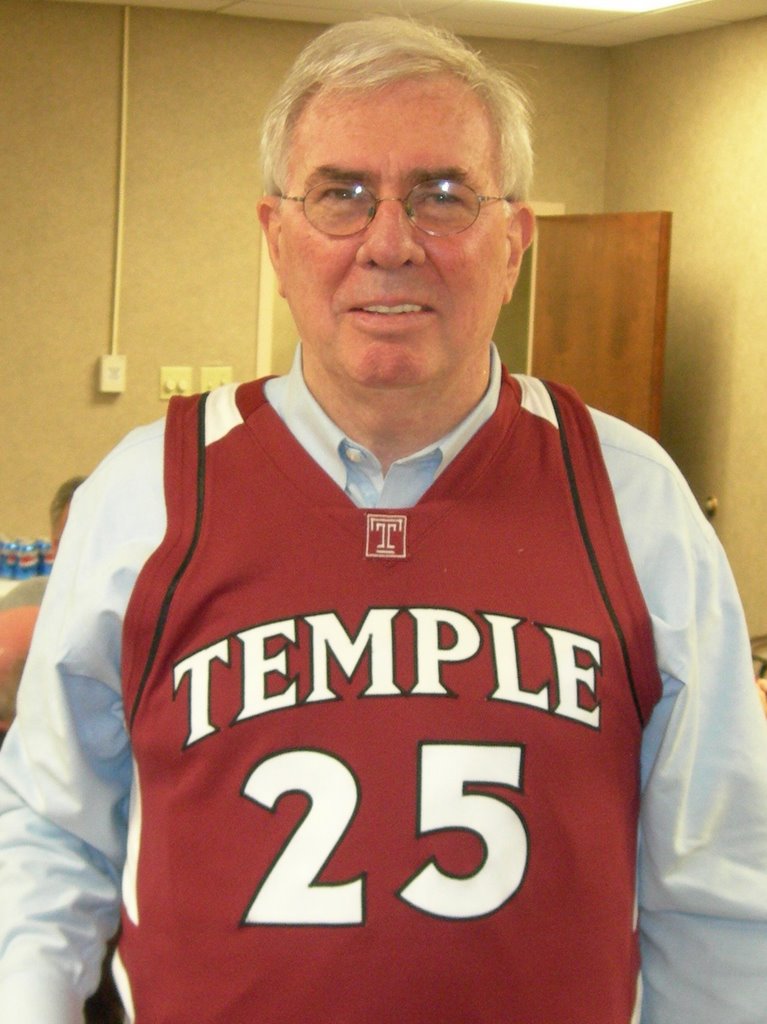
"Butch" Snethen
So, Elmer Snethen's sister sends an email to the new Temple basketball coach, Fran Dunphy. She wants to get a Temple jersey with Elmer's old number when he played at Temple in the 1960's. She eventually gets a reply telling her to give him a call. She does and begins explaining who Elmer is. Coach Dunphy interrupts her by saying, "Is this the same 'Butch' Snethen who used to play at Aronimink?" It so happened that he played pickup games in college with some of the "older" guys who had graduated. Here is "Butch" with his jersey.
Saturday, December 02, 2006
COMING TO THE LORDS TABLE..SUNDAY DECEMBER 3RD
Coming to the Table
Sunday we will be observing the sacrament of the Lord's Supper. In preparation, consider these words from John Calvin's Institutes:
Let us remember that this sacred feast is medicine to the sick, comfort to the sinner, and bounty to the poor; while to the healthy, the righteous, and the rich, if any such could be found, it would be of no value. For while Christ is therein given us for food, we perceive that without him we fail, pine, and waste away, just as hunger destroys the vigour of the body. Next, as he is given for life, we perceive that without him we are certainly dead. Wherefore, the best and only worthiness which we can bring to God, is to offer him our own vileness, and, if I may so speak, unworthiness that his mercy may make us worthy; to despond in ourselves, that we may be consoled in him; to humble ourselves, that we may be elevated by him; to accuse ourselves, that we may be justified by him; to aspire, moreover, to the unity which he recommends in the Supper; and, as he makes us all one in himself, to desire to have all one soul, one heart, one tongue. If we ponder and meditate on these things, we may be shaken but will never be overwhelmed by such considerations as these, how shall we, who are devoid of all good, polluted by the defilements of sin, and half dead, worthily eat the body of the Lord? We shall rather consider that we, who are poor, are coming to a benevolent giver, sick to a physician, sinful to the author of righteousness, in fine, dead to him who gives life; that worthiness which is commanded by God, consists especially in faith, which places all things in Christ, nothing in ourselves, and in charity, charity which, though imperfect, it may be sufficient to offer to God, that he may increase it, since it cannot be fully rendered.
Sunday we will be observing the sacrament of the Lord's Supper. In preparation, consider these words from John Calvin's Institutes:
Let us remember that this sacred feast is medicine to the sick, comfort to the sinner, and bounty to the poor; while to the healthy, the righteous, and the rich, if any such could be found, it would be of no value. For while Christ is therein given us for food, we perceive that without him we fail, pine, and waste away, just as hunger destroys the vigour of the body. Next, as he is given for life, we perceive that without him we are certainly dead. Wherefore, the best and only worthiness which we can bring to God, is to offer him our own vileness, and, if I may so speak, unworthiness that his mercy may make us worthy; to despond in ourselves, that we may be consoled in him; to humble ourselves, that we may be elevated by him; to accuse ourselves, that we may be justified by him; to aspire, moreover, to the unity which he recommends in the Supper; and, as he makes us all one in himself, to desire to have all one soul, one heart, one tongue. If we ponder and meditate on these things, we may be shaken but will never be overwhelmed by such considerations as these, how shall we, who are devoid of all good, polluted by the defilements of sin, and half dead, worthily eat the body of the Lord? We shall rather consider that we, who are poor, are coming to a benevolent giver, sick to a physician, sinful to the author of righteousness, in fine, dead to him who gives life; that worthiness which is commanded by God, consists especially in faith, which places all things in Christ, nothing in ourselves, and in charity, charity which, though imperfect, it may be sufficient to offer to God, that he may increase it, since it cannot be fully rendered.
Friday, December 01, 2006
CHARLES SPURGON ON WAITING
Know How to Wait
He that believeth shall not make haste. (Isaiah 28:16)
He shall make haste to keep the Lord's commandments; but he shall not make haste in any impatient or improper sense.
He shall not haste to run away, for he shall not be overcome with the fear which causes panic. When others are flying hither and thither as if their wits had failed them, the believer shall be quiet, calm, and deliberate, and so shall be able to act wisely in the hour of trial.
He shall not haste in his expectations, craving his good things at once and on the spot, but he will wait God's time. Some are in a desperate hurry to have the bird in the hand, for they regard the Lord's promise as a bird in the bush, not likely to be theirs. Believers know how to wait..
He shall not haste by plunging into wrong or questionable action. Unbelief must be doing something, and thus it works its own undoing; but faith makes no more haste than good speed, and thus it is not forced to go back sorrowfully by the way which it followed heedlessly.
How is it with me? Am I believing, and am I therefore keeping to the believers pace, which is walking with God? Peace, fluttering spirit! Oh, rest in the Lord, and wait patiently for Him! Heart, see that thou do this at once
He that believeth shall not make haste. (Isaiah 28:16)
He shall make haste to keep the Lord's commandments; but he shall not make haste in any impatient or improper sense.
He shall not haste to run away, for he shall not be overcome with the fear which causes panic. When others are flying hither and thither as if their wits had failed them, the believer shall be quiet, calm, and deliberate, and so shall be able to act wisely in the hour of trial.
He shall not haste in his expectations, craving his good things at once and on the spot, but he will wait God's time. Some are in a desperate hurry to have the bird in the hand, for they regard the Lord's promise as a bird in the bush, not likely to be theirs. Believers know how to wait..
He shall not haste by plunging into wrong or questionable action. Unbelief must be doing something, and thus it works its own undoing; but faith makes no more haste than good speed, and thus it is not forced to go back sorrowfully by the way which it followed heedlessly.
How is it with me? Am I believing, and am I therefore keeping to the believers pace, which is walking with God? Peace, fluttering spirit! Oh, rest in the Lord, and wait patiently for Him! Heart, see that thou do this at once
PRAYER REQUEST----PEG GREEN
Please pray for PEG GREEN she is in FranKford Hospital I spoke with her today on the phone she said she fell about a week ago, and did not think anything of it but when she did go to the hospital their are some broken bones in her back.
she is in good spirits and I will be visiting with her today, and will give an update on her condition.
Update: I visited with Peg today she seems to be in good spirits but is in pain, she does have three chipped bones in her tail bone area, the doctors want to send her for physical therapy out patient and possibly release her from the hospital tomorrow.
Lets keep Peg in our prayers
she is in good spirits and I will be visiting with her today, and will give an update on her condition.
Update: I visited with Peg today she seems to be in good spirits but is in pain, she does have three chipped bones in her tail bone area, the doctors want to send her for physical therapy out patient and possibly release her from the hospital tomorrow.
Lets keep Peg in our prayers
Subscribe to:
Comments (Atom)